How much does it cost to run a clothing business (Part 2: Production, Marketing & Distribution)
You have budgeted for design, sampling, and your website.
Now comes the bigger number.
Bulk production is the largest single cost in starting a clothing business — and it is the stage where most founders either make smart decisions or commit expensive mistakes that follow them for the next 12 months.
This is Part 2 of Bryden Apparel’s complete cost guide. It covers bulk production costs, advertising and marketing budgets, and distribution — the three cost centres that determine whether a clothing business is financially sustainable beyond its first collection.
At Bryden, we have helped more than 1,000 brands across 50+ countries plan and execute their first collections. Finances are what make or break a promising brand at this stage. The founders who get this right are almost always the ones who understood the full picture before committing capital.
Reading for the first time? Start with Part 1, which covers design, tech packs, sampling, and website setup.
The cash flow reality most guides skip
Before the cost breakdown, here is the single most important financial truth about starting a clothing brand.
The production-to-sale cycle for overseas full-package manufacturing is typically 5 to 7 months from tech pack sign-off to first customer sale. Capital is committed to production long before any revenue comes in.
Here is what that timeline actually looks like:
| Stage | Approximate timing | Cash position |
|---|---|---|
| Tech packs and sampling | Months 1 to 3 | Outflow |
| Bulk production deposit (typically 30%) | Month 3 | Outflow |
| Bulk production balance (typically 70% before shipment) | Month 5 | Outflow |
| Goods received, ready to sell | Month 6 | Holding stock |
| First sales revenue | Months 6 to 7 | Inflow begins |
Most new clothing brands need enough working capital to cover 5 to 6 months of outflow before meaningful revenue arrives. Building this into your financial plan before you begin is not optional — it is the difference between a brand that survives its first year and one that runs out of cash with stock sitting in a warehouse.

Cost centre 1: Bulk production
Cost: $5,000 to $25,000 (Dependent on your collection)
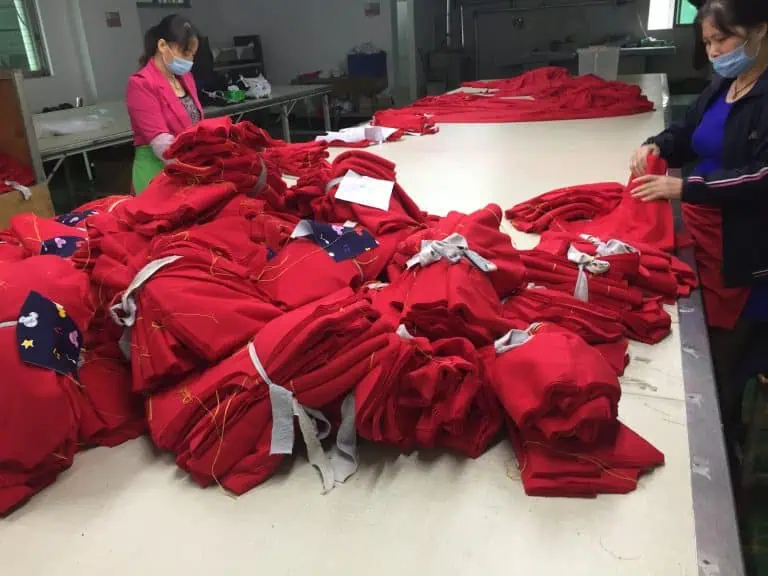
Once your pre-production sample is approved, the factory cuts and sews your full order. This is where the largest portion of your capital gets committed upfront.
The variables that drive your production cost
Minimum order quantity (MOQ)
Most factories set an MOQ per style per colour. Producing at or above MOQ is cheaper per unit because factories price based on run efficiency. But producing well above MOQ before your product has proven demand is a serious inventory risk.
A brand that orders 500 pieces of a style that moves slowly is sitting on dead inventory. That inventory ties up capital that should be funding the next collection, the next marketing push, and operations. One of the core reasons we built Bryden Apparel with an MOQ of 80-100 pieces per colour per design was precisely to give new brands a way to access cut & sew manufacturing at meaningful volume without overcommitting capital.
| Factory type | Typical MOQ | Best for |
|---|---|---|
| Large volume factory | 500 to 1,000 pcs per style per colour | Established brands scaling up |
| Mid-size factory | 300 to 500 pcs per style per colour | Brands on second or third collection |
| Low-MOQ specialist | 100 to 200 pcs per style per colour | New brands, first collections |
| Bryden Apparel | 80-100 pcs per colour per design | New / scaling brands, brands on second or third collection |
Where you manufacture
Manufacturing costs vary significantly by geography. Quality is not determined by geography, it is determined by factory capabilities, certifications, and quality control processes.
| Region | Cost level | Typical lead time |
|---|---|---|
| China | Low to medium | 8 to 14 weeks |
| Vietnam | Low to medium | 8 to 14 weeks |
| Bangladesh | Low | 10 to 16 weeks |
| Portugal or Turkey | Medium to high | 4 to 8 weeks |
| USA or UK | High | 4 to 8 weeks |
Bryden Apparel works exclusively with certified factories in China. We conduct quality control checks before every shipment and carry full documentation across our factory network.
Garment complexity
A plain single-jersey t-shirt costs significantly less to produce per unit than a structured jacket with multiple panels, interfacing, and hardware. Your production cost per unit reflects the labour, material, and machine time required per garment.
Indicative cost per unit (FOB, Asia):
| Garment type | Low | High |
|---|---|---|
| Basic t-shirt (cut-and-sew, no print or decoration) | USD 6 | USD 10 |
| Polo shirt | USD 10 | USD 15 |
| Hoodie | USD 16 | USD 30 |
| Structured jacket | USD 25 | USD 60 |
| Activewear top | USD 12 | USD 20 |
| Activewear set (top and bottom) | USD 25 | USD 35 |
| Board shorts | USD 15 | USD 25 |
These are indicative ranges only. Request a formal quote with a completed tech pack for accurate pricing.
What is FOB pricing? FOB (Free On Board) means the quoted price covers production and loading onto the export vessel at the origin port, but not freight, insurance, import duties, or last-mile delivery to your warehouse. Always confirm whether a manufacturer’s quote is EXW, FOB or DDP (Delivered Duty Paid) before comparing costs across suppliers.
Full-package vs. coordinating independently
| Approach | Coordination burden | Error risk | Best for |
|---|---|---|---|
| Full-package manufacturer | Low – handled for you | Lower | Most new brands |
| Coordinating vendors yourself | High – you manage everything | Higher | Brands with in-house production expertise |
For most new brands, the reduced coordination overhead and lower error risk of full-package manufacturing more than justifies any cost difference. When I was manufacturing Ardentees independently, the cost of errors like wrong fabrics arriving, trim mismatches, factory miscommunications far exceeded what a full-package service would have cost.
Pro tip: Find a manufacturing partner who provides both convenience and offers a low minimum order so that you can cut down on your inventory risk and get the most bang for your buck.
Cost centre 2: Advertising and marketing
Typical range: USD 500 to USD 3,000 per month for an early-stage brand
Marketing is not optional for a new clothing brand. Even a well-made product with strong photography will not sell consistently without deliberate, sustained investment in building awareness. The brands I have seen succeed in their first year all have one thing in common: they started marketing during production, not after stock arrived.
Traditionally, advertising would often mean buying ad spaces in print and on television, and marketing efforts would constitute sending out samples to PR agencies, media companies and participating in trade shows for example. These are some costs to account for if you’re taking a more traditional approach.
Here is a practical breakdown of the most commonly used digital advertising channels and what they actually cost.
Paid social (Meta: Facebook and Instagram)
The most measurable and scalable channel for direct-to-consumer clothing brands.
| Budget | What to expect |
|---|---|
| Under USD 500 per month | Insufficient data for algorithm optimisation |
| USD 500 to USD 1,000 per month | Can test 3 to 5 ad sets and start learning what converts |
| USD 1,000 to USD 2,500 per month | Structured campaigns with clear ROAS targets |
| USD 2,500 or more per month | Scaling stage — only justified after proving conversion rates |
TikTok
Currently the highest organic reach potential of any major platform, particularly for brands targeting the 18 to 35 age group. Behind-the-scenes manufacturing content, founder-led storytelling, and try-on content all perform well. For paid TikTok, a starting budget of USD 300 to USD 800 per month is workable for niche-specific clothing brands.
Google Search advertising
Effective for brands targeting customers actively searching for a specific product category. Starting budget: USD 300 to USD 800 per month for category-specific campaigns.
Influencer and creator marketing
| Tier | Followers | Cost per post | Best for |
|---|---|---|---|
| Nano (seeding) | 1,000 to 10,000 | Product only | Hyper-niche brands |
| Micro | 10,000 to 100,000 | USD 100 to USD 500 | Best ROI for new brands |
| Mid-tier | 100,000 to 500,000 | USD 500 to USD 2,000 | Brands with proven conversion |
| Macro | 500,000 or more | USD 2,000 or more | Awareness at scale |
Micro-influencers in your specific niche consistently outperform large accounts with broad audiences in terms of conversion rate. Niche relevance matters more than follower count.
Email marketing
The highest-ROI channel for clothing brands at every stage. Email subscribers convert at significantly higher rates than social media followers because they have explicitly opted in. Klaviyo, the standard platform for e-commerce brands, starts at USD 45 per month for up to 1,500 contacts.
Pro Tip: Start marketing even before you get the products. Create your social media account and think of creative ways to create curiosity about your brand and products. Go local and get your first customers from your home turf.

Cost centre 3: Distribution
Variable – depends on your sales model
Depending on your business model, selling directly to consumers or to retailers for wholesale or consignment will incur different costs.
Selling directly to consumers can mean setting up a brick-and-mortar store or an e-commerce store. As a start-up label, opting for e-commerce can definitely help you to save on the overhead costs of a physical store such as rent, renovation & furnishing and employment of sales staff. However, this goes back to knowing who your target market is and what their buying habits are. If you’re starting a luxury brand for example, you might lean more towards brick-and-mortar, as traditionally, consumers under the luxury demographic prefer to shop in physical stores.
Direct-to-consumer e-commerce
| Cost | Typical range |
|---|---|
| Payment processing | 2 to 3% per transaction |
| Shipping to customer | USD 5 to USD 20 per order |
| Returns handling | 5 to 15% of orders depending on category |
| Third-party fulfilment if used | USD 2 to USD 6 per order |
Wholesale to retailers
Standard wholesale pricing is 50% of recommended retail price. A garment you sell at USD 80 retail sells to a retailer at USD 40 against a production cost of USD 15 to USD 25. Wholesale only works financially if your retail price is built with that margin structure in mind from the start.
The recommended sequence: Launch direct-to-consumer first. Build 3 to 6 months of sell-through data from your own channels. Then approach wholesale buyers with that data. In my experience, a buyer is far more likely to take a serious meeting with a brand that can show existing sell-through than one approaching them cold with no sales history.
As you calculate your costs in your financial plan, always check against your budget and ensure that you don’t exceed it so that you avoid overspending in areas where you shouldn’t and spend in areas where you should.
Your first-year budget across three scenarios
| Cost centre | Lean launch | Balanced launch | Invested launch |
|---|---|---|---|
| Design and tech packs | USD 500 | USD 1,500 | USD 3,000 |
| Sampling | USD 600 | USD 2,000 | USD 5,000 |
| Bulk production | USD 3,000 | USD 8,000 | USD 18,000 |
| Website and setup | USD 400 | USD 800 | USD 2,000 |
| Photography | USD 500 | USD 1,200 | USD 3,000 |
| Marketing (6 months) | USD 1,500 | USD 6,000 | USD 15,000 |
| Total | USD 6,500 | USD 19,500 | USD 46,000 |
Important: This is a first-year budget, not just a launch budget. Reorder capital is not included here. Budget a further 50 to 70% of your initial production cost for your first reorder once sell-through data confirms which styles to scale.
Frequently asked questions
How much should I budget for marketing as a new clothing brand? USD 500 to USD 2,000 per month is a realistic starting range for an early-stage direct-to-consumer brand. Below USD 500 per month, paid advertising campaigns do not generate enough data to optimise effectively.
Is manufacturing in Asia actually better value? Generally yes. Production costs in China, Vietnam, and Bangladesh are significantly lower per unit than equivalent production in Western Europe or the US. The trade-off is longer lead times — typically 8 to 14 weeks for bulk production — and higher freight costs. For most international clothing brands, the cost difference more than offsets the logistics premium.
What is the difference between FOB and DDP pricing? FOB means the quoted price covers production and loading at the origin port, but not freight, insurance, duties, or last-mile delivery. DDP means the manufacturer covers everything to your door. Always confirm which basis you are comparing when getting quotes from different suppliers.
How do I reduce inventory risk on a first bulk order? Work with a manufacturer that offers a low MOQ, start with fewer styles than you think you need, and pre-sell where possible through pre-order campaigns or wholesale commitments before finalising your bulk quantity.
When should I consider wholesale distribution? After 3 to 6 months of sell-through data from your own channels showing consistent demand. A brand with no sales history is a difficult conversation with any buyer. Lead with your data, your photography, and a clean line sheet.
In Conclusion
The costs involved in starting a clothing line will differ from brand to brand as every label’s business model and requirements are different. However, it is useful to remember that starting small and comfortable can help to save a lot of initial costs and allow you to focus on managing parts of your business that are more important in the early stages of the label – design, marketing and distribution for example.
Lower MOQs mean lower inventory risk and less capital committed upfront. Full-package service means lower coordination costs and fewer expensive production errors. Factory certifications mean a brand story with real, verifiable substance.
Managing your finances is crucial to the sustainability of your brand. Drawing up a financial plan that includes the potential costs mentioned above can help to give you a fair gauge on how much you need to spend/can save.
Remember to constantly update the plan as you go along too so that you are always well aware of your financial status, which will allow you to make decisions for the business responsibly and more easily. This is important so that you know not to burn a hole in your pocket before you even make a sale.
Bryden Apparel is a Singapore & China based full-package custom clothing manufacturer. MOQ starts at 80-100 pieces per colour per design with a 480-500-piece total order minimum designed to make professional manufacturing accessible for brands producing their first collection.
Get in touch with Bryden Apparel to discuss your project and get a quote for your collection.