A private label clothing manufacturer is a factory that produces garments exclusively for your brand according to your design, your fabric spec, and your construction standard, with no other brand able to buy the same product. The right manufacturer takes your brief and delivers a product that is genuinely yours. The wrong one takes your money, ships something that doesn’t match your sample, and disappears when you raise a complaint. Choosing correctly is the most consequential sourcing decision your brand will make.
I’ve been running Bryden Apparel, since 2013. Over that time I’ve helped hundreds of brands navigate the process of finding the right manufacturer and I’ve seen what goes wrong when brands rush it. Here’s everything you need to know before you commit to a clothing manufacturer.

What does a private label clothing manufacturer actually do?
A private label clothing manufacturer produces garments that are exclusive to your brand. The product is designed for you, manufactured to your specification, and not sold to any other buyer.
This is the core distinction between private label and white label manufacturing. In white label, the factory produces a generic product and sells it to multiple brands who each apply their own label. In private label, the product is built from your brief and belongs to your brand alone.
The test is simple: can another brand buy the same garment from the same factory? If yes, it’s white label. If no, it’s private label. Many manufacturers use both terms interchangeably in their marketing but the distinction matters enormously for your brand’s competitive position.
The three types of private label clothing manufacturer
Not every manufacturer that claims to offer private label manufacturing actually does. Understanding the three production models helps you identify what you’re actually being offered.
Full-package private label manufacturer
A full-package manufacturer manages the entire production process from design development, tech pack creation, fabric sourcing, pattern making, sampling, bulk production, quality control, packaging, and export. You bring a brief. They deliver a finished, exclusive product. This is the highest-service model and the right choice for brands without an in-house production team.
Bryden Apparel operates on this model. When a brand comes to us with an activewear brief or a uniform program, we take it from concept to finished product, they don’t have to source fabric, develop patterns, or manage factory relationships in China directly.
OEM private label manufacturer
An OEM (Original Equipment Manufacturer) produces to your design specifications. You provide the tech pack, fabric spec, and construction details, and the factory sources materials and manufactures to match. You own the design. The factory manages production execution. OEM suits brands with an in-house design team that can produce detailed tech packs but doesn’t want to manage a fabric supply chain.
CMT private label manufacturer
CMT (Cut, Make, Trim) manufacturers provide labour only, you will have to supply the fabric, patterns and all trims, and the factory cuts and sews to your spec. CMT is genuine private label but the sourcing burden means it’s only cost-effective for brands with established fabric supplier relationships and production management expertise already in place.
What separates a good private label clothing manufacturer from a bad one
1. They have a real sampling process
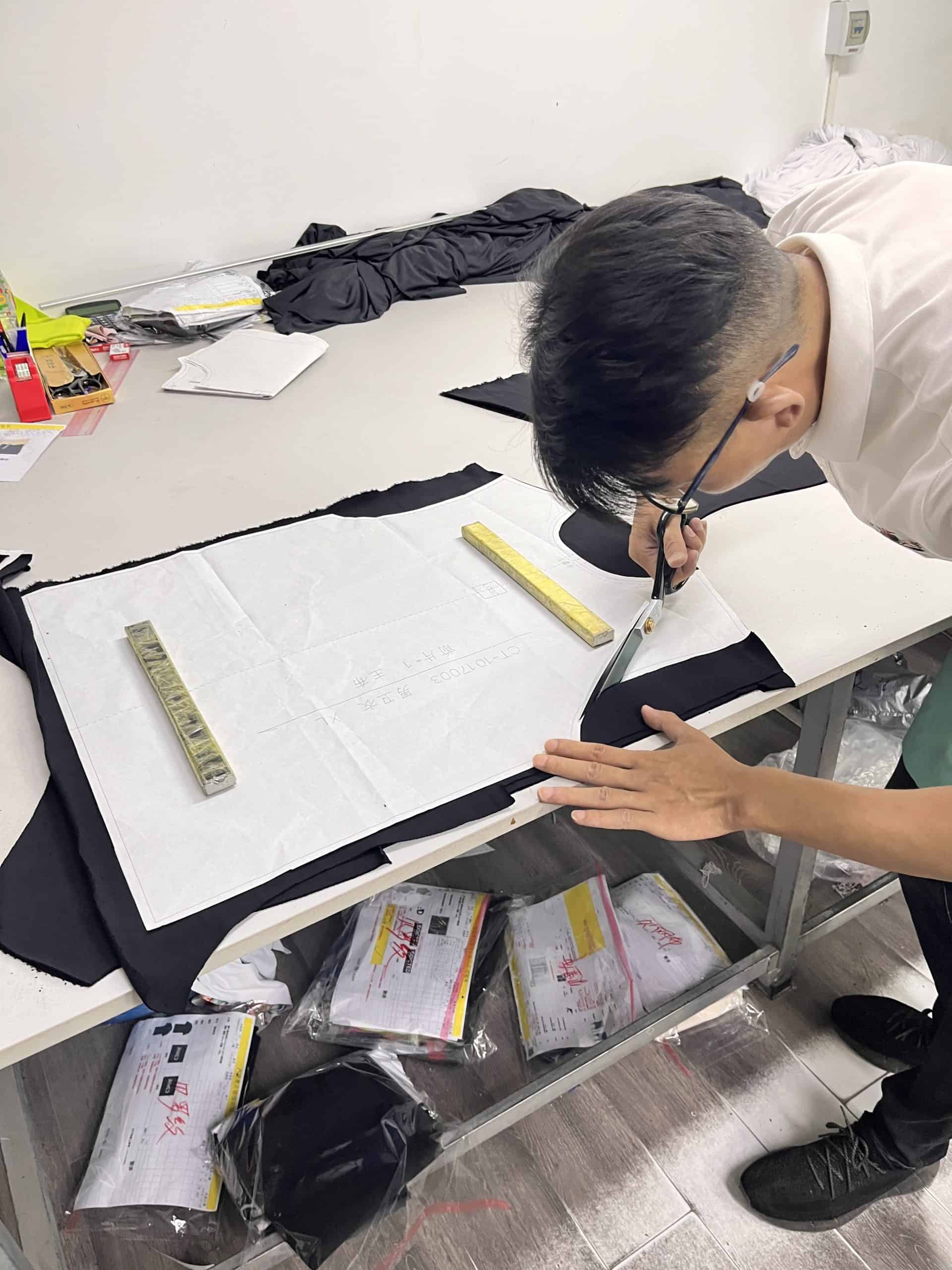
A credible private label clothing manufacturer has a defined sampling workflow from first sample, fit sample, pre-production sample and can tell you exactly how long each stage takes.
They charge for samples because they’re investing real time and materials in your product development. Manufacturers who offer “free samples” with no clear development process are almost universally decorating blanks, that’s white label, not private label.
2. They ask for a tech pack or help you build one
Any manufacturer serious about private label production needs a tech pack before bulk production begins. A full-package manufacturer will help you develop one from your brief. An OEM manufacturer requires you to supply one. Either way, the tech pack is non-negotiable, it’s the document that defines what you’re agreeing to produce and protects you if the factory deviates from spec.
A manufacturer who says they don’t need a tech pack and can work from photos or mood boards is telling you they’re going to interpret your brief however they want. That usually ends badly.
3. They have a documented QC processes
Ask any manufacturer you’re evaluating: what quality control happens at pre-production, in-line, and pre-shipment stages? Can they show you inspection reports from recent production runs?
A factory with genuine QC systems can answer these questions specifically, they’ll tell you they do in-line checks after the first 10-20% of production, that they use AQL 2.5 for major defects at pre-shipment, that their QC team produces written reports at each stage. “We have strict quality control” is not a QC process. It’s marketing language.
4. They are transparent about their factory network
Private label clothing manufacturing in China often operates through networks like sourcing companies, trading companies, and agents who work with factories rather than owning them directly. There’s nothing wrong with this, but you need to know whether you’re working with a factory directly or with an intermediary. Ask directly: do you own the factories that produce my garments, or do you work with a network of partners? How do you certify and monitor those factories?
At Bryden, we work with 34 factory partners in China. We’re transparent about this. Our clients know their production is matched to the most appropriate factory for that garment category and every factory in our network has been audited against our compliance standards.
5. Their MOQ makes sense for your order size
MOQ for private label clothing manufacturing typically ranges from 100 to 500 pieces per style depending on the manufacturer, the garment, and the production model. Be cautious of manufacturers with no stated MOQ or very low MOQs as they’re almost always working from blanks or catalogue styles rather than building a genuinely custom product from raw fabric. At Bryden, our MOQ is 80-100 pieces per colour per design with a 500-piece minimum across a total order.
Red flags when evaluating a private label clothing manufacturer
They can’t show you samples of their own work. Every credible manufacturer has a sample library or a portfolio of past production. If they can’t show you anything beyond stock photography or unbranded garments, ask hard questions about where those garments were actually made.
Their lead times are unrealistically short. Full private label development from brief to approved pre-production sample typically takes 8-14 weeks with a full-package manufacturer. Bulk production adds another 4-6 weeks. Any manufacturer promising private label production in 3-4 weeks total is either working from blanks or cutting corners on sampling.
They don’t ask about your tech pack or offer to help develop one. If a manufacturer is happy to go straight to production from a photo or reference garment without a documented spec, there’s no agreed standard to hold them to when the product arrives.
They’re evasive about factory certifications. If your brand needs GOTS, GRS, or OEKO-TEX certified production and the manufacturer can’t produce documentation, walk away. Ask for the certificate number and check it against the certifying body’s database.
Their pricing is significantly below market. Below a certain unit cost, you’re not getting real product development, real fabric quality, or real QC. Prices that seem too good to be true almost always are.
How to brief a private label clothing manufacturer
The quality of your brief determines the quality of your outcome. A good brief includes:
Product description. What is the garment, what is its intended end use, and who is the target customer. A men’s technical running short has completely different construction requirements to a men’s casual short. The manufacturer needs to understand the end use to make appropriate technical decisions.
Reference garments or sketches. Send a physical reference garment with elements of what you want, or clear annotated sketches with dimensions. Photographs from multiple angles work. Pinterest mood boards do not.
Fabric requirements. Composition, weight in GSM, structure (woven, knit, fleece), and finish. If you don’t know the technical spec, describe the performance or hand-feel properties you need, please let the manufacturer recommend options.
Colourways, size range, and order quantity. How many colours, how many sizes, how many total units. This determines whether your order is viable at the manufacturer’s MOQ and affects fabric purchasing calculations.
Target delivery date and budget. Work backwards from your launch date when evaluating lead times. If you have a target FOB price per unit, share it, it will save time for both sides.
Private label clothing manufacturing costs – what to budget
Sampling: Typically USD $100-$200 per sample per round. Budget for two to three rounds per style before you have an approved pre-production sample.
Development time: 8-14 weeks from brief to approved pre-production sample with a full-package manufacturer.
Unit cost: Highly variable by garment, fabric, and order volume. A basic cut and sew t-shirt at 500 units might be USD $7-$9 FOB. A technical jacket at the same quantity might be USD $25-$50 FOB. Full-package unit costs are higher than CMT because you’re paying for sourcing and development services, not just production labour.
Total landed cost: FOB unit cost plus freight, import duties, and destination warehouse handling. This is the number your retail margin model needs to work against, not just the FOB price alone.
Frequently asked questions
What is a private label clothing manufacturer?
A private label clothing manufacturer is a factory that produces garments exclusively for one brand to their design specifications and these designs are not sold to any other buyer. This is distinct from white label manufacturing, where the factory produces a generic product sold to multiple brands who rebrand it. Private label can be delivered via full-package manufacturing, OEM, or CMT, the three models are covered in detail above.
What is the difference between a private label and white label clothing manufacturer?
A private label clothing manufacturer produces an exclusive product for one brand. A white label manufacturer produces a generic product sold to multiple brands who rebrand it. The test is simple: can another brand buy the same garment from the same factory? If yes, it’s white label. If no, it’s private label. Many manufacturers use the terms interchangeably in their marketing but the distinction matters enormously for your brand’s competitive position.
What MOQ do private label clothing manufacturers require?
MOQ for private label clothing manufacturers typically ranges from 50 to 500 pieces per style depending on the manufacturer, garment type, and production model. Full-package manufacturers have higher MOQs because they make upfront fabric and trim commitments on your behalf. At Bryden Apparel, the MOQ is 100 pieces per colour per design with a 500-piece minimum across a total order. Manufacturers offering private label with no MOQ are almost always working from blanks, not building custom garments from raw fabric.
How long does private label clothing manufacturing take?
From brief to delivery, private label clothing manufacturing typically takes 14-20 weeks with a full-package manufacturer. This includes 8-14 weeks for design development and sampling, and 4-6 weeks for bulk production and shipping. Timelines vary by garment complexity and how quickly the brand approves samples at each stage. Any manufacturer promising full private label production in under 8 weeks total should be questioned carefully.
How do I find a reliable private label clothing manufacturer in China?
Look for manufacturers with documented factory certifications, a clear sampling process with defined stages and timelines, transparent QC systems including in-line and pre-shipment inspection, and a portfolio of past production you can verify. Ask for client references at a similar stage to yours. Avoid manufacturers who can’t show you inspection reports, won’t discuss their factory network, or offer pricing significantly below market. Trade shows like Canton Fair and sourcing platforms are starting points but due diligence on any manufacturer you shortlist is non-negotiable.
What certifications should a private label clothing manufacturer have?
The relevant certifications depend on your product and target market. GOTS (Global Organic Textile Standard) certifies organic fibre processing. GRS (Global Recycled Standard) certifies recycled content claims. OEKO-TEX Standard 100 certifies garments are free from harmful substances. ISO 9001 certifies quality management systems. Always request the certificate number and verify it directly with the certifying body, certification claims are common, verified certifications are fewer.
What is the difference between a full-package and CMT private label manufacturer?
A full-package private label manufacturer manages everything from brief to delivery. A CMT manufacturer provides cut and sew labour only and you supply the fabric, patterns, and trims. Both produce exclusive private label products. Full-package suits brands without an in-house production team. CMT suits brands with established sourcing capabilities who want maximum material control.